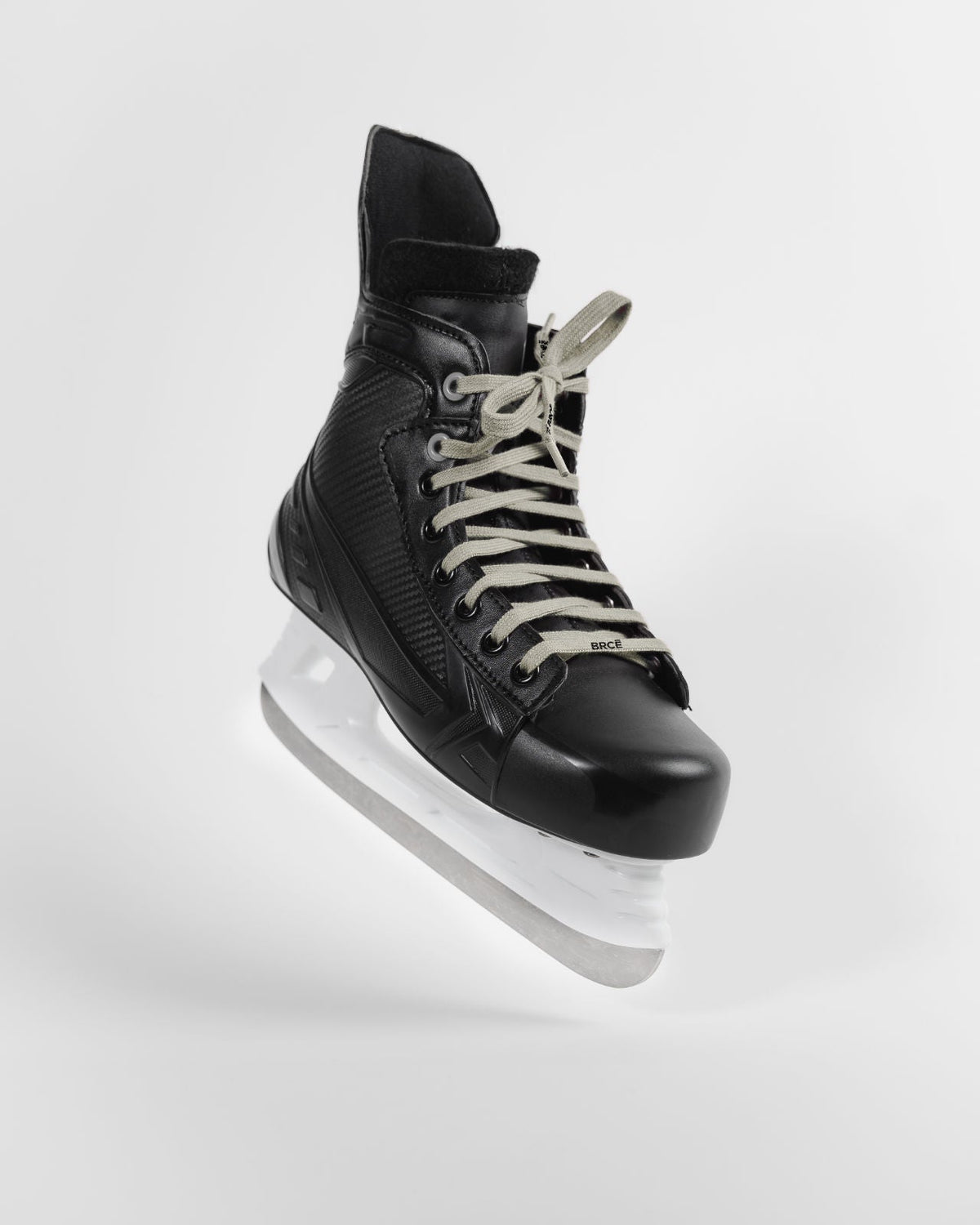
Hockey laces do more than hold your skates shut. The right lace determines how consistently you can maintain tension during a game, how securely your foot and heel stay in place, and how much pressure builds across the top of your foot. Hockey players also put their laces through a lot of abuse: frequent tightening, flexing, moisture, and abrasion during practice and games.
This guide covers what you need to know about choosing the right hockey laces, including lace length, construction, tension, width, pressure, and when to replace them.
How Do BRCĒ Hockey Laces Stay Secure Without Wax?

BRCĒ Hockey Laces use Lattice-Grip® surface architecture to build grip into the lace. Tiny surface structures interact where the lace crosses itself and forms a knot, helping resist slippage and maintain the tension you set.
That means fewer interruptions to retie and a skate fit designed to feel more consistent through a shift. BRCĒ’s wider, structured flat profile and minimal-to-no stretch let you set tension by section, while the unwaxed construction keeps a clean, non-sticky feel.
What Should You Look for in Hockey Laces?
The best hockey laces are the right length for your skates, built to handle repeated tightening, and hold consistent tension without causing discomfort. BRCĒ Hockey Laces combine a wider, structured flat profile with minimal-to-no stretch and Lattice-Grip® surface grip to help maintain that fit.
What Makes a Good Hockey Lace?
Hockey laces must withstand repeated stress without stiffening or losing their ability to stay secure. The skate’s rigid eyelets can also cause wear and tear on the laces.
When buying hockey laces, consider:
- Length: Your laces should reach the eyelets you use and leave enough length for a secure knot. Too long, dangling loops can become tripping hazards.
- Durability: Repetitive tightening and contact with eyelets can cause fraying and surface wear. BRCĒ Hockey Laces are designed to resist fraying around rigid skate eyelets.
- Grip: A lace’s surface affects how well it interacts with itself when crossed and tied. BRCĒ’s grip comes from Lattice-Grip® surface architecture within the lace itself.
- Tension retention: Laces should retain tension as you skate rather than shifting or loosening. BRCĒ’s surface grip helps resist slippage at the crossings and knot to hold your chosen tension.
- Width: Choose a width that fits your skate’s eyelets. BRCĒ Hockey Laces are wider and more structured than our other athletic lines.
- Comfort: The laces and skate should provide a secure fit without creating unnecessary pinch points.
- Fray resistance: Continued tightening may cause friction and damage laces over time.
- Adjustability: Laces should be easy to adjust and retie. BRCĒ Hockey Laces can be loosened and retied when you need to adjust the fit.
- Moisture resistance: Hockey laces are exposed to sweat, water, ice, and cold temperatures, so construction can affect their durability and performance. BRCĒ Hockey Laces are designed to resist moisture-related performance changes.
Waxed vs. Unwaxed Hockey Laces
Hockey players often have to choose between waxed and unwaxed hockey laces. BRCĒ uses unwaxed hockey laces because Lattice-Grip® builds grip into the lace itself.
Wax is one way to add grip to a hockey lace. With BRCĒ, Lattice-Grip® surface architecture creates mechanical interaction where the lace crosses and ties, helping resist slippage and hold the tension you set without an applied wax coating.
Staying unwaxed gives BRCĒ Hockey Laces a clean, non-sticky feel, with no wax coating to crack, peel, or wear away. You can still loosen and retie the laces whenever your fit needs adjusting.
|
Feature |
Conventional Waxed Hockey Laces |
BRCĒ Unwaxed Hockey Laces |
|
Grip |
Applied wax coating on the lace surface |
Lattice-Grip® grip built into the lace |
|
Holds tension |
Depends on the lace and coating condition |
Surface architecture helps resist slippage |
|
Ease of adjustment |
Feel varies with construction and coating |
Loosen and retie as needed |
|
Feel |
Wax-coated surface |
Clean, non-sticky feel |
|
Moisture response |
Varies by lace and coating |
Designed to resist moisture-related performance changes |
|
Coating wear |
Wax can wear over time |
No wax coating to crack, peel, or wear away |
|
Construction |
Varies by product |
Wider, structured flat profile with minimal-to-no stretch |
What Length Hockey Laces Do You Need?
The correct hockey lace length depends on more than your skate’s size. The skate’s design, the number of eyelets, lacing method, and your preferred tying style all factor into your needed length.
Before buying replacement hockey laces, take into account the following factors:
- Skate size
- Number of eyelet pairs
- Whether you use every eyelet
- Your preferred lacing technique
- How much lace you want left for tying
Your laces should reach the top of the skate, leaving enough length to create a secure knot. But it is still best to avoid too much lace to reduce wear on laces and tripping. However, laces that are too short can make it hard to achieve the tension you want.
If you are unsure what length you need, remove your existing laces, lay them flat without stretching them, and measure from end to end. Use a pair that already gives you enough lace for a secure knot without oversized loops or tails as your starting point.
BRCĒ Hockey Laces are offered in 96- and 108-inch lengths. For example, if your current laces measure 108 inches and give you a comfortable knot with manageable tails, use 108 inches as your starting point. Check that the lace width also fits your skate’s eyelets.
How Tight Should Hockey Skates Be Laced?
Hockey skates should feel secure around the heel and midfoot without causing numbness, pinching or excessive squeezing across the top of the foot. Players often want enough tension to keep the foot stable without pulling every section as tight as possible. With BRCĒ Hockey Laces, use standard crisscross lacing and set that tension by section.
Consider your feet’s comfort in each zone as follows:
- Forefoot: Ensure there is enough space for easy movement without your foot wiggling inside the skate.
- Midfoot: Use even pressure to keep your foot secure and limit unnecessary movement.
- Ankle: Tension should be adjusted to your preferred support and mobility. Players who prefer additional ankle security can use a firmer ankle-lock zone without overtightening the rest of the skate.
- Heel: Your heel should remain secure inside the skate without noticeably lifting or sliding.
How Does Lace Tension Affect Skate Fit?
Lace tension dictates how pressure is distributed across the skate. Uneven or excessive tension can create painful pressure points, while low lace tension can lead to unnecessary foot or heel movement in the skate.
Instead of tightening every section of your skate, adjust tension based on how your skate fits your foot. BRCĒ Hockey Laces combine minimal-to-no stretch with grip at the crossings and knot to help maintain the tension you choose for each section.
What Is Hockey Lace Bite?
Hockey lace bite is pain or irritation across the front or top of the ankle caused by concentrated pressure from the skate tongue or laces. BRCĒ Hockey Laces use a wider, flat profile to help distribute lace pressure across the top of the foot.
Some possible causes of lace pressure include:
- Overtightening laces
- Concentrated pressure on the instep
- Skate fit
- Skate tongue structure
- Repeated bending of the ankle
BRCĒ’s Lattice-Grip® helps hold your chosen tension, so you can aim for a secure fit without overtightening the instep. Changing your laces’ structure, width, and tightness may affect how pressure is distributed, but hockey laces cannot treat hockey lace bite or another medical condition. If pain continues, players should evaluate their overall skate fit and consult a professional.
Why Do Hockey Laces Come Loose?
Hockey laces flex, change tension, absorb moisture, and move throughout a game. Over time, worn surfaces may also affect how well the lace maintains its tension. Laces can loosen from repeated flexing, vibration, movement, changing tension, worn lace material, poor knot security, and exposure to water and moisture.
BRCĒ Hockey Laces address that movement with Lattice-Grip® at the crossings and knot. The surface structures interact under tension to help resist slipping, while the wider construction and minimal-to-no stretch help maintain the skate fit you set before play.
How to Keep Hockey Laces Secure During Play
BRCĒ Hockey Laces use Lattice-Grip® at the crossings and knot to help the laces stay tied as the skate flexes. Start with a comfortable fit, then use the checklist below to keep tension balanced through play.
- Start with even lace tension.
- Tighten by section rather than pulling everything equally hard.
- Use a secure knot.
- Keep excess lace under control by either tucking it in or double-knotting.
- Replace frayed or stretched laces.
- Choose a lace construction that reliably maintains tension.
- Recheck your laces before taking the ice.
Standard Hockey Laces vs BRCĒ Performance Hockey Laces
|
Feature |
Standard Hockey Laces |
BRCĒ Performance Hockey Laces |
|
Adjustable tension |
Yes |
Yes |
|
Designed for repeated athletic use |
Varies |
Yes |
|
Knot security |
Varies |
Lattice-Grip® helps resist knot slippage |
|
Tension consistency |
Varies |
Designed to help maintain chosen skate tension |
|
Durability |
Varies |
Designed to take skate-eyelet abrasion and moisture |
|
Stretch |
Varies |
Minimal-to-no stretch |
|
Traditional tying |
Yes |
Yes |
BRCĒ Hockey Laces combine a wider, structured flat profile with minimal-to-no stretch and grip built into the lace without the need for a wax coating.
How BRCĒ Hockey Laces Are Designed to Maintain Tension
BRCĒ Hockey Laces use Lattice-Grip® surface architecture to create grip and hold tension through the lace itself. Unlike traditional waxed laces that rely on an applied coating, our patented technology increases mechanical contact where the laces cross themselves. This helps knots resist loosening and supports more consistent tension throughout your skate.
BRCĒ Hockey Laces are designed with:
- Lattice-Grip® micro-hooks and micro-ridges that help resist knot slippage
- More consistent tension through repeated skating movements
- Resistance to moisture-related performance changes in wet and cold rink conditions
- Resistance to fraying caused by rigid skate eyelets on traditional skate laces.
- A wider, structured flat construction with minimal-to-no stretch
BRCĒ’s wider, structured profile and minimal-to-no stretch give you control as you tighten each section of the skate. Lattice-Grip® then helps maintain that chosen tension at the crossings and knot. The unwaxed surface feels clean and non-sticky, with no wax coating to crack, peel, or wear away. You can still loosen and retie the laces when you need to adjust your fit.
BRCĒ has appeared on ABC’s Shark Tank. Learn more about the patented material technology behind BRCĒ laces.
Explore BRCĒ Hockey Laces
Hockey-Specific Durability Testing
BRCĒ has developed a hockey-specific testing program based on the stresses laces endure during training and games. The program focuses on knot security, tension retention, tensile strength, stretch, eyelet abrasion, and wet and cold conditions.
|
Test |
BRCĒ Test Results |
|
Knot security |
No complete untying and no more than 3 mm of lace migration after 10,000 repeated-tension cycles. |
|
Tension retention |
Maintain at least 90% of initial tension in dry conditions and at least 85% after wet and cold conditioning. |
|
Tensile strength |
Withstand at least 120 kgf of force or perform at least 20% stronger than a leading waxed hockey lace. |
|
Controlled stretch |
No more than 5% elongation under representative skating loads and no more than 2% permanent stretch after the load is removed. |
|
Eyelet abrasion |
Withstand at least 25,000 abrasion cycles against representative hockey-skate eyelets without breaking. |
|
Wet-strength retention |
Maintain at least 90% of dry tensile strength after exposure to water and artificial perspiration. |
When Should You Replace Hockey Laces?
You do not need to wait for your hockey laces to break before choosing a pair that better supports your skate fit. Switching to BRCĒ Performance Hockey Laces gives you Lattice-Grip® grip designed to resist knot slippage and maintain more consistent tension without waxing.
For a hockey player, that means fewer interruptions to retie and a skate that feels more consistent through a shift. Keeping loose lace ends under control also helps address a potential trip hazard. Choose the right lace length and set a comfortable fit in properly fitted skates.
Should You Wrap Hockey Laces Around Your Ankles?
Some hockey players tie their hockey laces around the ankle after lacing the skate. However, this can change how tension is distributed around your ankle and may restrict movement depending on your skate’s fit and your technique. Wrapping laces should not be used to compensate for a poorly fitted skate. BRCĒ recommends standard crisscross lacing. Choose a lace length that leaves enough room for a secure knot without needing to wrap the excess around your ankle.
FAQs
Are BRCĒ Hockey Laces waxed?
No. BRCĒ Hockey Laces use Lattice-Grip® surface architecture to create mechanical interaction where the lace crosses itself rather than relying on a conventional wax coating. The payoff is a clean, non-sticky feel and grip built into the lace, with no wax coating to crack, peel, or wear away. You can still adjust and retie them as needed.
Are BRCĒ Hockey Laces made for ice hockey or roller hockey?
While BRCĒ Hockey Laces are designed for the demands of ice hockey, you can also use them for roller hockey skates, as long as the selected lace length and width match the skate’s eyelets and lacing path.
What length hockey laces do I need?
The correct length depends on skate size, number of eyelets, and lacing style. Laces should be long enough to tie securely without leaving excessive loose material. For BRCĒ Hockey Laces, measure a well-fitting current pair end to end without stretching it, then compare that measurement with the listed 96- and 108-inch lengths.
How tight should hockey skates be laced?
Hockey skates should feel secure around the heel and midfoot without causing numbness, pinching, or excessive pressure. With BRCĒ Hockey Laces, use standard crisscross lacing and adjust tension by section.
Why do hockey laces keep coming loose?
Repeated flexing, changing tension, worn material, smooth lace surfaces, and knot movement can all cause hockey laces to loosen during play. BRCĒ Hockey Laces use Lattice-Grip® to help resist knot slippage and maintain your chosen tension as the skate flexes.
What is hockey lace bite?
Hockey lace bite is discomfort or irritation across the top/front of the ankle caused by concentrated pressure from the skate tongue and laces. BRCĒ Hockey Laces have a wider, flat profile designed to help distribute lace pressure; they are not a treatment for lace bite.
Can changing laces reduce lace pressure?
Different lace widths, materials, and tension patterns can alter how pressure is distributed, but persistent discomfort may also relate to skate fit or tongue construction. BRCĒ Hockey Laces use a wider, flat profile to spread lace pressure and Lattice-Grip® to help hold the comfortable tension you set.
Are flat laces better for hockey skates?
Flat laces are common in hockey because they provide broad surface contact and can distribute tension over a larger area. Material and construction still matter. BRCĒ Hockey Laces combine that flat profile with a wider, structured construction and minimal-to-no stretch.
How often should hockey laces be replaced?
There is no single replacement schedule for every player. Consider switching to BRCĒ Performance Hockey Laces when you want grip designed to resist knot slippage and help keep your chosen skate tension consistent, even if your current laces have not worn out.